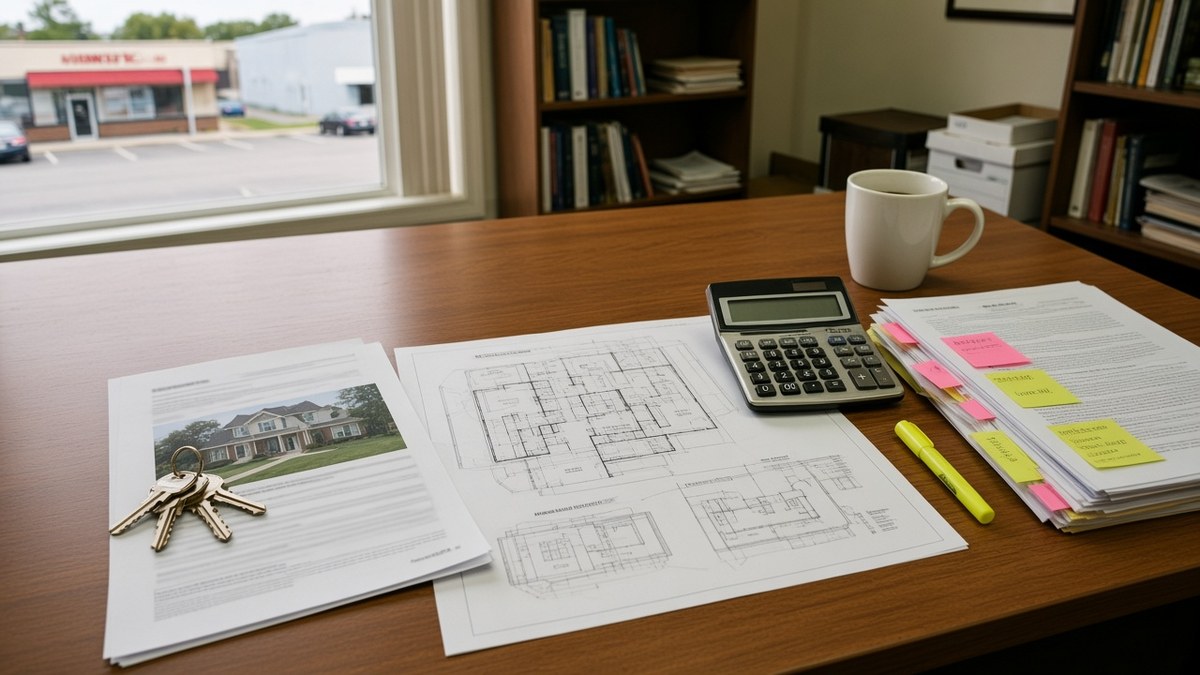
It usually starts with a phone call. A buyer you helped into their first house a few years ago now owns a bakery, and the bakery is doing well enough that they want a second location. They trust you, so they ask: can you help with this?
If you're trying to figure out how to transition from residential to commercial real estate, the good news is that you aren't starting from zero. The hardest part of commercial work is guiding a person through a decision that will shape the next several years of their life, and you've done that hundreds of times. This guide covers what carries over, what will cost you, and what the first 18 months tend to look like, with the money laid out honestly.
How commercial real estate work splits up
In residential, the same agent often lists one home and represents a buyer on the next. Commercial work divides more sharply, so it helps to see the whole map before you pick a spot on it.
The first divide is who you represent. A tenant rep works for the business that needs space. They learn how the business operates, find the options, tour them, and negotiate the lease, and they're usually paid out of the landlord's listing commission through a split with the listing broker (here's a fuller explanation of tenant representation). A landlord rep, also called a listing rep, works for the owner of the building. They hold the listing, market the space to tenants and their brokers, and negotiate for the owner, who pays the commission (our guide to landlord representation covers the owner's side). Investment sales is a third path. Instead of leasing space, you help owners buy and sell buildings as investments, and the work leans heavily on income analysis.
The second divide is property type. Office, retail, industrial and distribution, flex, medical and labs, multifamily, and land each have their own decision-makers and timelines. The common advice is to choose one side and one property type, which we come back to below.
Same license, different job
Do you need a different license for commercial real estate?
In most states, no. Tennessee's commission says no separate license is needed. Illinois says there is "no separate classification for commercial," and then adds the part that matters: a broker "must be skilled in the area he/she chooses to practice."
So can a residential real estate agent do commercial deals? Legally, yes, starting tomorrow, and that is exactly why it's risky.
Why being allowed is different from being ready
The real gate is competence. Article 11 of the NAR Code of Ethics bars you from providing services outside your expertise unless you bring in help or tell the client, as NAR explains.
The legal ground shifts too. Residential law leans toward protecting consumers, while courts generally treat both sides of a commercial deal as sophisticated parties, so "I didn't understand the lease" rarely works as a defense.
CCIM for residential agents, and SIOR later
The CCIM designation can be finished in as little as a year, though it often takes longer (is CCIM worth it? goes deeper on the question). The 2026 total is about $8,286 for members or $11,810 for non-members, covering four core courses, ethics, a portfolio of qualifying experience, and a comprehensive exam.
SIOR requires roughly five years of active industrial or office brokerage, minimum production levels, and endorsements from existing members. CCIM is the realistic early signal that you're serious, and SIOR is one to aim at around year five.
What carries over from residential, and what will cost you
The useful way to compare a residential vs commercial real estate agent is by which habits help and which ones hurt.
The skills that transfer
You know how to walk a person through a move that scares them, and a lease is a life event for a business owner. Taking a bigger warehouse because the orders finally caught up is the same kind of decision as buying a first home, with payroll attached.
Your patience with stressed clients carries over, and so does your follow-up discipline, which matters more when a deal takes months. Your community network is full of small business owners. You already know how to read a client's face in a doorway, and if you've negotiated with an emotional seller, you're ready for landlords, who can be just as attached to a property.
The habits that backfire
The first habit to drop is expecting a 30 to 45 day close. A commercial lease commonly takes two to four months, and even small leases can run six to twelve months from first meeting to signature.
The second is comparing asking rents. Under a triple net (NNN) lease, the tenant pays a share of property taxes, insurance, and common area maintenance (CAM) on top of base rent, while under a gross lease the landlord carries those costs (Investopedia explains the difference). Tenants also pay for a share of the lobby and hallways, which is why rentable square feet are larger than usable square feet.
The third is assuming one person decides. In commercial there is often an owner, a partner, a CFO, and a lawyer, and they don't always want the same thing.
The $234,000 air conditioning clause
NAR tells a story that explains why commercial leases need a different kind of reading. A lease charged $65 an hour for air conditioning outside normal business hours. Over a five-year lease, it cost the tenant $234,000.
Your client is a business with a story
Most guides to becoming a commercial real estate agent treat the work as buildings and math, but the person across the table is usually a founder signing a first lease or a team that has outgrown its space. They're deciding where the next chapter of their business happens.
That changes your questions. A business owner's needs come out in how the business runs: where the employees live, how deliveries arrive, whether customers walk in, and how much the team might grow before the lease ends. Ask about the plan first, because the square footage follows from it. On the listing side, the owner is a person too, and can be as attached to a building as a homeowner is to a house.
Pick a lane: property type and which side you represent
Which commercial property type is easiest to start in?
Each property type has its own decision-makers and timelines, and a career piece from FirstBank points out that three years in industrial don't transfer cleanly to office.
No type is easy, but your network gives you an edge with small multifamily, mixed-use buildings, small businesses that occupy their own space, and small landlords. Agents who made the switch also tend to advise starting in leasing rather than investment sales, unless you already "know your way around a financial model."
Should you start in tenant rep or landlord rep?
Both are real paths with honest tradeoffs. Tenant rep works a lot like buyer agency, which makes it familiar for new brokers coming from residential. The tenant usually pays nothing directly, because your fee comes out of the landlord's listing commission through a co-broker split, often 50/50. The tradeoff is that clients can slip away. If a tenant tours a space with the listing agent before committing to you, the question of who earned the commission gets messy, so get the client committed to you in writing early (why that commitment slips away, and what helps).
Listing rep works more like taking a residential listing. You represent the owner, the owner pays the commission, and your job is to get the space leased on good terms. The tradeoff is that you need inventory, meaning owners willing to hand you their buildings, and a newcomer usually starts with none. A residential network helps here, because it often includes small landlords and owners of small buildings.
The search no longer comes from the MLS
This change surprises residential agents most, and it shows up on both sides. In residential, the MLS does much of the work: buyers' agents set up searches, and a listing reaches every agent in town the day it goes live. In commercial leasing, a tenant rep builds the search by hand, and a listing rep has to work to get each space in front of the tenants and brokers who are actually looking.
From requirement to survey
On the tenant side, it starts with a written requirement covering size, area, budget, timing, must-haves, and how the business actually operates. From that you build a survey, which is a set of options with your judgment added. A good one has verified availability and real occupancy costs, a page for each property with your own notes, a map, and a comparison built around what this client cares about. Keeping it clean and readable takes real work (more on why market surveys get messy).
On the listing side, the job runs the other way. You start with a space and look for the businesses it fits, which means accurate details, real costs, and steady contact with tenant brokers working active searches.
Gravitate exists for this part of the job on both sides, because whether you're sending a client a survey or putting a listing in front of people who are actually looking, what matters is that the right space reaches the person whose plans it fits.
The tour, the recap, and the LOI
A tenant rep puts the tour book in driving order and sends a recap the same day with the client's reactions and an updated comparison. On the listing side, you're often the one showing the space, and the questions a touring tenant asks tell you a lot about whether it fits.
Then comes the letter of intent (LOI), a non-binding term sheet that sets the main terms before anyone drafts a lease. Rent matters, but much of the negotiation is about tenant improvement (TI) money, which is what the landlord puts toward the build-out, along with free rent, annual increases, renewal options, and the right to sublet if the business changes.
The money: the first 18 months on a calendar
How do commercial real estate commissions work, and when do you get paid?
Lease commissions are usually a percentage of the total lease value, often 4 to 6 percent, paid by the owner.
Here's a worked example. A three-year lease on 2,000 square feet at $20 per square foot per year is worth $120,000. At 5 percent, the commission is $6,000. When one broker represents the landlord and another represents the tenant, they commonly split that 50/50, so each side gets $3,000. Each broker then splits with their firm, and at 50/50, which is the most common arrangement, each takes home $1,500. House splits range from 50/50 to 90/10.
Half at signing, half at occupancy
Leasing commissions are usually paid half when the lease is signed and half when the tenant moves in or starts paying rent.
Picture it on a calendar. You meet a client in month two. The search, tours, LOI, and lease take about six months, so the lease is signed and the first half arrives in month eight. The build-out takes another six months, and the second half shows up around month fourteen. That deal went well, and it still took more than a year to pay out in full. Don't spend the second half before it arrives.
How much money should you save before switching to commercial?
Meaningful income commonly takes six to eighteen months. A first-year planning guide from MaxLife suggests planning on zero commission for the first 90 days and gives a simple runway formula: monthly expenses times the months until your first check, plus three months of cushion. A common rule of thumb among people who've done it is twelve months of expenses in reserve.
How much do commercial real estate agents make in their first year?
There is no reliable figure for commercial real estate agent income in the first year. The closest broad figure is NAR's 2026 Member Profile, which puts median gross income at $8,000 for members with two years or less in the business across all property types, as MaxLife notes.
Beyond that, agents who made the switch share anecdotes, and they are anecdotes rather than averages. One was told by a commercial team to expect "$0 for the first year, $100k 2nd year… $250k 3rd year." One leasing broker said serious money takes about five years, because that's "when the people you called 4 years ago start to take you seriously" and their small deals come up for renewal.
Team, mentor, or solo
What does a commercial real estate mentor actually do for you?
The advice is nearly universal: join a team or a senior broker in one property type. "If you go solo and don't specialize in an asset, you will get lost," one agent warned.
A good commercial real estate mentor shares their deal pipeline. A weak one hands you flyers and leaves you cold calling for two years. The FirstBank piece says that if a mentor brings you into a live negotiation over TI money, "you will learn more in that hour than in six months of reading lease forms."
Know the trade. The senior broker brings in the business and takes most of the commission, and you do much of the work at their direction, often for three to five years.
Should you do residential and commercial real estate at the same time?
This one is contested. One agent who became a top producer in his market told a residential agent to "close the books on your residential business," arguing that agents who do both kill deals and get avoided. On the other side, Hondros and voices quoted by NAR say to keep your residential income while you build, as long as you truly train for commercial and pay the commercial MLS dues.
For most agents with a mortgage, the runway math makes doing both the realistic path at first. If a commercial deal ever waits on a residential closing, it's time to choose.
If your brokerage already has a commercial side
Many big residential brokerages have a sister commercial arm, so the question becomes how to switch from residential to commercial real estate alongside colleagues who already do it.
Refer it, co-broke it, or move over
The usual internal model is a referral. You keep the relationship and earn a fee, and the commercial agent runs the deal. NAR says 60 to 70 percent of residential agents accept a referral fee when it's offered, and suggests an easy way to put it to the client: you're busy and want them to get the best service.
A fee on a deal that closes beats a deal lost to a clause you didn't catch. Better still, ask to co-broke or shadow the deals you refer, which gives you an apprenticeship without changing desks.
What does a referral fee look like?
Industry practice and agent reports land on 20 to 25 percent of the commercial agent's gross commission, with 25 percent the most common and up to 30 percent on large deals. Referrals are paid broker to broker and should be in writing before you make the introduction.
Moving over without burning bridges
Working commercial deals yourself can make you look like competition to your own commercial office. Some commercial veterans see a residential transfer as a liability, and NAR describes them reciting "a litany of why it's a bad idea."
A path that tends to work is to refer and co-broke with your commercial arm, shadow the deals you refer, and pick one property type. Move over when you have the runway saved and a mentor who will share their pipeline, and expect to start under a senior producer at a lower split.
Frequently asked questions
Is commercial real estate harder than residential?
In some ways it is, because deals take longer and the money arrives later, but the people side tends to come naturally to agents from residential.
How long does it take to close your first commercial deal?
Plan on months rather than weeks, since even a small lease can run six to twelve months from the first meeting.
How do I find my first commercial client?
Start with people who already trust you. Past buyers who own businesses and sellers who own small rental buildings are natural first clients. Tell them you're doing commercial work now.
Is it worth switching from residential to commercial real estate?
It can be, if you can fund the runway and find a mentor who shares real deals. If you need steady income soon, make referrals and co-brokering your first step into a commercial real estate career change.
The part you already know
The agents who do well in commercial are rarely the ones who learned cap rates fastest. They're the ones who remember that every lease belongs to someone, whether it's an owner opening a second location or a founder signing their first lease. You've spent years helping people through moves like that. The buildings and the paperwork are new, but the person across the table needs the same thing from you that your homebuyers did.